

I did it again this week!! Half-justifying my Saturday night to a colleague, like spending three hours back inside Stardew Valley needed a permission slip. “I know, I know, it’s basically a kids’ game,” I said, before she’d even asked. She hadn’t asked. And it’s not a kids’ game anyway. GAH!
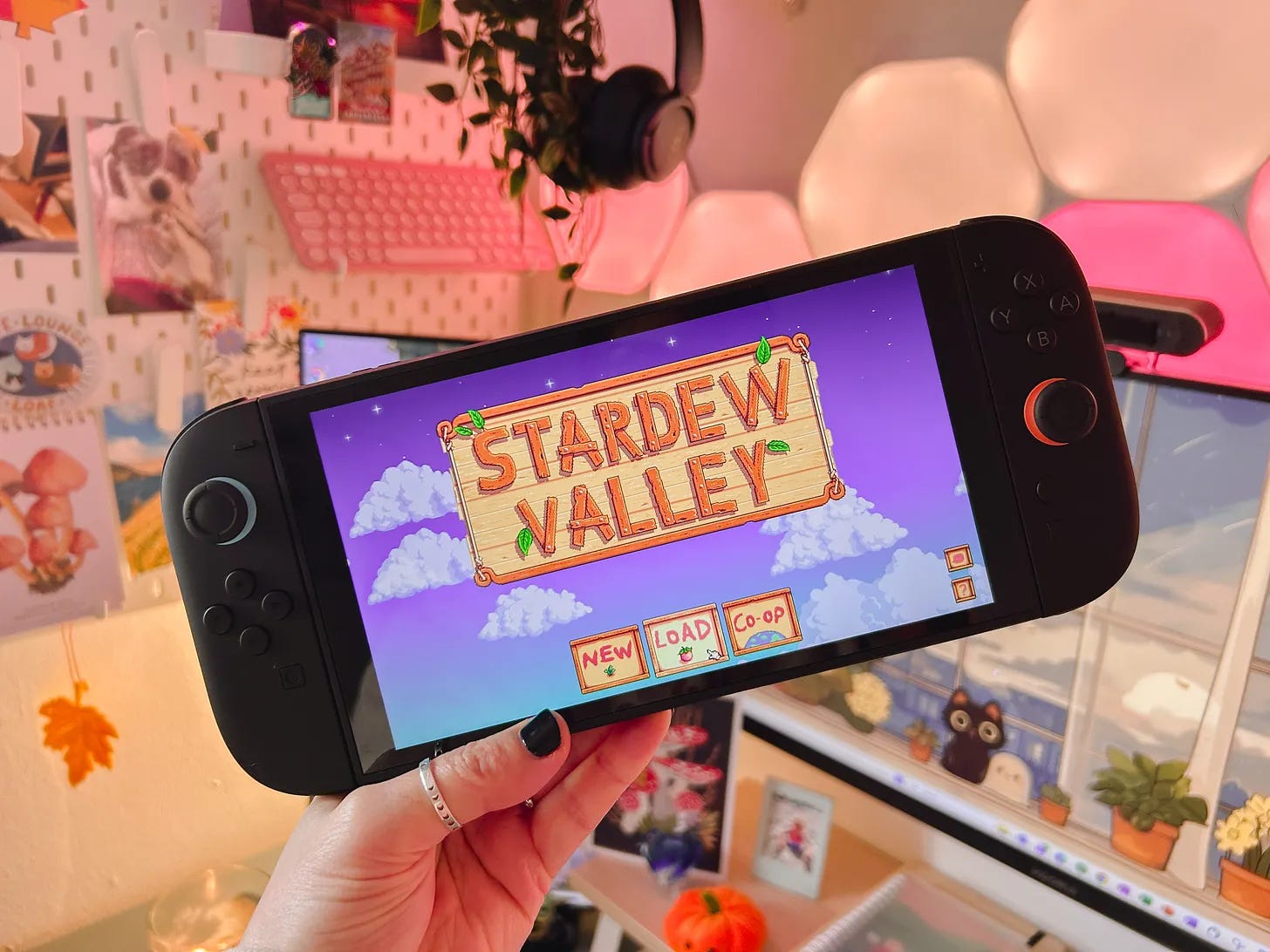
That flinch might be familiar to you too, if you grew up being told gaming was something you’d eventually grow out of. Except here we are, well into our forties, still doing it.
What’s actually changed is that the research is catching up with what a lot of us already knew. The average gamer is now 411, not some teenager in a basement, and a University of Oxford study2 has been looking specifically at whether playing games affects our wellbeing, and finding that, mostly, it does, but not in the way the old headlines warned us about.
This study has led me to ask perhaps a silly question: why do we still treat gaming as a guilty pleasure at all?
Tens of thousands of players were surveyed worldwide, and the numbers aren’t subtle: 72% of European players say games help them feel less stressed, 56% say they ease loneliness, and globally those figures climb even higher; 70% reporting less anxiety, 64% crediting games with making them feel less isolated. People aren’t just having fun, they’re naming actual real benefits.
What the Oxford study isn’t saying
It’s not the “screen time will rot your brain” study we’ve all had thrown at us before. It’s more like how people feel after they play, particularly when the playing fits around their actual life rather than consuming it. Which probably describes most of us. We’re not bingeing for twelve hours straight (good God, if only I could). We’re fitting in an hour after the kids are in bed, or a lunch break, or — fine — a Saturday night with an old game we’ve already finished twice.
So gaming isn’t inherently good or bad, any more than reading or cross-stitching is. It depends entirely on what it’s doing for you. For most of us past 40 we choose it on purpose, often the one part of the evening that’s actually ours.
Nobody questions a Netflix binge, but everyone questions your Switch
Nobody asks if your evening in front of the TV was “productive.” Nobody side-eyes a long bath or a crossword. But if I spend the evening gaming I can feel people recalculating their opinion of me. Or maybe I’m just paranoid, let me know in the comments.
The global report backs up exactly what my instinct is picking up on, though.
For a lot of players, gaming isn’t just a distraction, it’s doing the job decompression, escapism and connection are supposed to do. After a long day, it’s the thing that switches my brain off when a book can’t hold my attention and the telly’s too passive for my ADHD brain. When we write that off as frivolous, we’re really writing off the need underneath it that is rest, autonomy, a bit of control over something, however small.
Gaming still drags around old stereotypes; laziness, isolation, arrested development, and none of it really matches the women in their forties I actually know who play.
Pleasure doesn’t need to be earned first. I’m done pretending otherwise.
Where cosy games come in
The Oxford study wasn’t about cosy games specifically, but it’s not hard to see why the genre and the findings line up so neatly. Games that let you put the controller down without losing three hours of progress, that lean on atmosphere and story over reflexes and punishment, is the whole appeal of cosy gaming, and apparently it’s doing more than just being quite nice. It’s also why a slow little game like Animal Crossing can do more for an exhausted Tuesday than something twice as flashy.
You don’t need my permission, or anyone else’s
So if you’re over 40 and still gaming, there’s nothing here to minimise. You haven’t failed to grow out of something, you’ve just kept hold of a hobby the research is finally catching up to!
And if you’re properly new around here: welcome. This is where I write about exactly this. Cosy and narrative games, the odd deep dive like this one, reviews from someone with zero patience left for unnecessary difficulty spikes, and no guilt attached to any of it. Have a dig through the archive, and subscribe if you’d like more of this landing in your inbox.
☕ Fancy a cosy gaming session? I stream cosy games live every Friday and Sunday. If you'd like somewhere relaxed to chat about games while we play, I'd love to see you there!
https://www.theesa.com/resources/the-global-power-of-play-report/
https://royalsocietypublishing.org/rsos/article/9/7/220411/96718/Time-spent-playing-video-games-is-unlikely-to
I will be 43 this year and gaming is my favourite hobby. Yet I know what this feeling is, like I'm embarrassed to admit it. When my wife reads in bed every night and I stay up to play games instead, I do have this guilty feeling - like I should also be reading too, that's the more accepted way to relax, the more "grown up" hobby because you can talk about books with lots more people than about games.
But playing games is what makes me happy. They engage my brain with problem solving, they take me away to a different place where I'm more in control and more likely to succeed. I usually feel I've accomplished something by the end of the night by completing a level or checkpoint.
Having written about my love of gaming for nearly a year now, it makes me happy I'm not the only one who enjoys it. I'm glad I get to meet a lot more like minded people now, like yourself.
I do think there's still some stereotype carried over on gaming. It's begining to be uncommon, but some people still relate it with being an inferior activity related to kids and making kids sexist and/or violent. I still don't understand where this stereotype came from